
On Darkness
Or how an Etruscan sculpture may make the coming winter a little more bearable

We changed our clocks this weekend in Italy, falling back into the autumn (for now) and the winter (to come—ugh). Every year since reading Wintering I have convinced myself that I will master it this time around. This year I will be cozy and slow and not try to run myself ragged with work and projects during the time of year meant for hibernation. I will not fall prey to seasonal depression because I will make sunny soups all winter and I will go for walks in all manner of temperatures just to feel the air on my face. I will not fight the darkness, I will give myself over to it. You can do this, I tell myself, you can be present in the winter and not just dream about spring for the next five months.
In this attempt to settle into the encroaching darkness, I have been meditating on a sculpture and on a poem that I think might help me do just that.
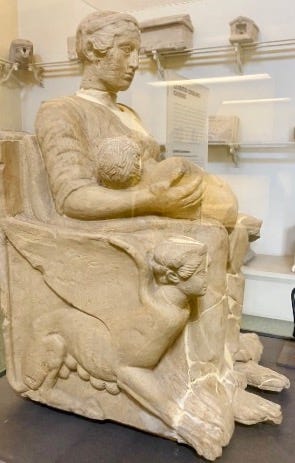
This beauty, found at the Archeological Museum of Florence is officially identified as a Mater Matuta—the mother of the morning—a Latin divinity associated with sunrise, fertility, and birth who would eventually be subsumed into the Roman pantheon and equated with their goddess Aurora. It makes sense to see her as a mother goddess, it depicts a solidly seated woman who is holding a baby in her arms, after all. But if we look more closely, another option for her identity presents itself.
The statue sits majestically in the center of a room otherwise filled with Etruscan burial urns—small caskets made to hold the ashes of the dead. When our statue was excavated in the Necropolis della Pedata in Chianciano Terme (near Siena) in 1846, they discovered that her head and her feet were removable.
Inside they found a burial urn.
Rather than a Mater Matuta, could we be looking at a depiction of Tujltha, the Etruscan protectress of the dead? Less Aurora, more Proserpina1 Queen of the Underworld? Can we see this anthropomorphic burial urn not as a symbol of sunrise but as a symbol of darkness? I think so.
Persephone 3
By Marie Howe
My mother knows all about the under-dark.
She needn’t have pretended to be appalled.
The seed must break open and rise;
put too deep the rot sets in.
My mother is a god; she wanted to spare me.
But my nature is nature.
Like everything alive I was meant to be split open,
to blossom, to be sucked, to be eaten,
to lean, to bend, to wither,
to die and die and die and die until I died.
Like everything in nature, the darkness serves a purpose—it cocoons us, swaddles and protects us after we have been split open during the blossoming spring. So this winter I am going to think about this 2,500-year-old statue and channel my inner Tujltha, my shadowy Proserpina, and revel in the under-dark of it all.
Proserpina is the Roman equivalent of the Greek Persephone.
My inner Classics major felt all tingly reading this:
"Rather than a Mater Matuta, could we be looking at a depiction of Tujltha, the Etruscan protectress of the dead? Less Aurora, more Proserpina¹ Queen of the Underworld? Can we see this anthropomorphic burial urn not as a symbol of sunrise but as a symbol of darkness?"
The shape and form of the statue is breathtaking - I am imagining a sleep-deprived, breastfeeding mother at about 2 am. Symbol of darkness, indeed.
More of this, please! Gorgeous piece.
What a gorgeous poem