
Florence in your mind
How to be here (without actually being here) this summer

Summer Book Club is TONIGHT at 6pm CEST on Zoom. We are discussing Veronica Raimo’s Lost on Me and are thrilled to have the book’s translator, Leah Janeczko, joining us. It’s free and open to all—register here to receive the link. See you soon!
It’s no secret that I find Florence difficult in the summer. This in no way makes me unique—I don’t know anyone who loves this place from June through August (say what you want about the city being tranquilla during Ferragosto but honestly who wants to be in an oven even if you can easily find a parking spot?). We all turn into goblins ceaselessly whinging about the heat and the crowds, counting the days, hours, minutes until the vacanze begin and take us away from it all.
But even as I write this, I know many of you are thinking you’d be happy to be in Florence even in the baking temps. I get it, I really do. Florence is magical and wondrous and inspiring, no matter the season. So how can you be here without actually being here? Fear not—I’ve got a class, a ritual, some research ideas, and a few reading recommendations that will get you to Florence in your mind.
Take a class
Spend July with me in Florence—from the comfort of your own home, of course. On Thursdays from July 2nd to 23rd we will gather for an online series, The Secret Lives of Masterpieces, all about the invisible stories behind 100 of Florence’s most intriguing artworks from the ancient to the Baroque. As always, it will be both live and recorded for those who can’t make it at the scheduled time.
The guiding question of the series is: If this art could talk, what would it tell us?
Perhaps it is a story about the little face peering out at us, or a repaired disaster, centuries of languish in a place not its own, the heartbreak of a patron. Perhaps the story is about survival—of flood, mud, fire, landslides, vandalism, war, and time. Maybe they would tell us about the lives lived by the people who created and intentionally collected them.
Through their stories we enter into the world of the artwork—we wander the Etruscan tomb, pray in the medieval cathedral, skirt danger the in the Renaissance city, and negotiate a price for the precious pigment so crucial to success.
This is not a classroom but time travel; we will make human contact across the centuries. This is the history of art from the art’s point of view.
(n.b. I have purposefully kept the price low for this course—it costs E. 100 for four sessions and have also included a two-for-one option if you would like to share with a friend. Even though the world now disgustingly has its first trillionaire I know that things are tight for most people and I hope this is an accessible option.)
Do a Florentine ritual
John the Baptist is our patron saint and we celebrate his birth on June 24th, right at the summer solstice. John is known as the last prophet—the one whose light dims to make way for the light of Christ, whose birth is celebrated at the return of the light (the winter solstice). There were various ancient water and fire festivals held around the summer solstice and in Florence we incorporate the fire element through a fireworks show over the Arno on the night of the 24th.
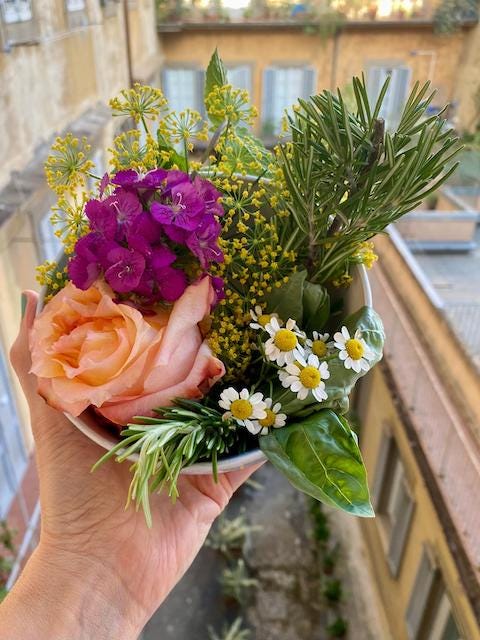
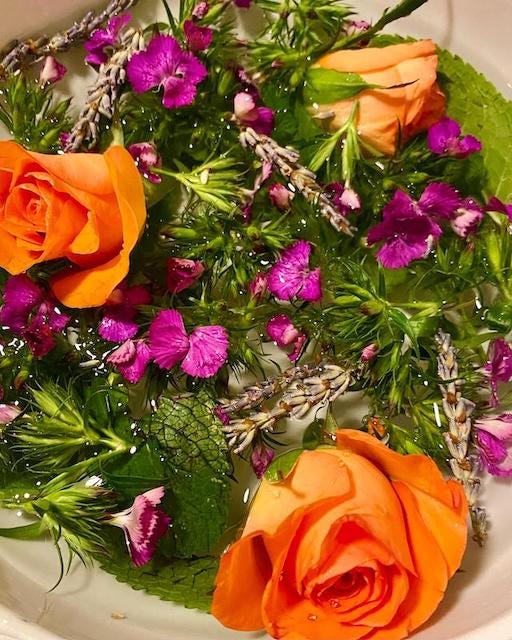
The water element is the one that you can do from anywhere, thereby bringing the spirit of Florence straight to you. On the evening of June 23rd, we make miracle water, also known as “acqua di San Giovanni”. Mine usually has some combination of rose, lavender, mint, rosemary, and Sweet William, but you can choose any type of flowers or herbs that are blooming where you are right now. Put your bounty in a bowl full of clean water and leave it outside on the night of the 23rd to be blessed by the Madonna and St. John the Baptist. The water will also be enchanted by little spiritelli—protective spirits—who come in the form of the dew to offer their own blessing for the coming summer and harvest season. On the morning of the 24th, wash with the water and—this is important—if there is any left over you must give it to friends, family members, your neighbors, etc. as the water must be completely used up by the evening of the 24th. May miracles abound!
Start a deep dive on a particular Florentine topic
Researching for pure fun is all the rage these days and I have to say, I love that. (Just please—I implore you—do not use a chatbot for this research. It should be done in the spirit of intellectual amusement.) Go to your library and check out books, watch YouTube video essays, lectures, and documentaries (made by humans), search Academia.edu for FREE scholarly articles on your topic.
Ideas for a Florentine hyper-fixation:
-an illustrious member of the Medici family
-one single artist (Sandro Botticelli, Filippo Brunelleschi, Piero di Cosimo, Bronzino, and Plautilla Nelli are all VERY Florentine, for example)
-one single author (Dante, Machiavelli, Oriana Fallaci, etc.)
-charitable institutions in Renaissance Florence
-the history and use of pigments like lapis lazuli, cinnabar, minium, etc. in Florentine painting and manuscript decoration
-a history of the 1966 flood and the restoration that followed
-the Virgin Mary in Florentine art
Read a summer diary
A Florence Diary by editor and memoirist extraordinaire, Diana Athill, is a tiny jewel of a book that will immediately transport you to August 1947 and a two-week trip she took with her cousin Pen. It is so delicious that it makes me think summer in Florence isn’t actually all that bad. Here is an excerpt:
Monday, 1 September 1947 and Tuesday, 2 September 1947
“Both mornings we spent in the Museo di San Marco, which is the monastery in which Fra Angelico lived and worked. The downstairs rooms are full of his paintings and those of his school, and the cells upstairs each have a fresco, some of them by him. The longer you look at the paintings the more heavenly they become. They have a sort of early May morning freshness about them and the people all seem as though, if you watch them a moment more, they will complete the gestures they’re making, and you can tell by their faces what they are thinking, particularly in the big deposition from the Cross. We have felt about so many things ‘It would have been worth coming to Florence just to see that’—but of the Fra Angelico it is superlatively and utterly true.
We also discovered the peaches during the last two days. For some reason we had only bought figs and grapes before, and the pensione peaches are only middling. But yesterday we bought a couple of the monsters that cover the stalls—each weighing about half a pound, and golden colored—not believing for a moment that they could be as luscious as they looked—and oh bliss! Oh rapture! Oh poop poop! They are peaches grown in Fra Angelico Paradise. We ate them in the lovely cloisters, pouring juice in a very vulgar way all over everything.”
Utterly divine!
I really loved this one!
I enjoyed your traversal of Dante's Commedia Divina at the British Institute (via Zoom). Looking forward to Secret Lives of the Masterpieces!